


'I Swear' Review: Robert Aramayo Gives Tourette's Humanity, Humility, and Humor in Otherwise Dry Biopic
- Matthew Creith

- Apr 24
- 3 min read
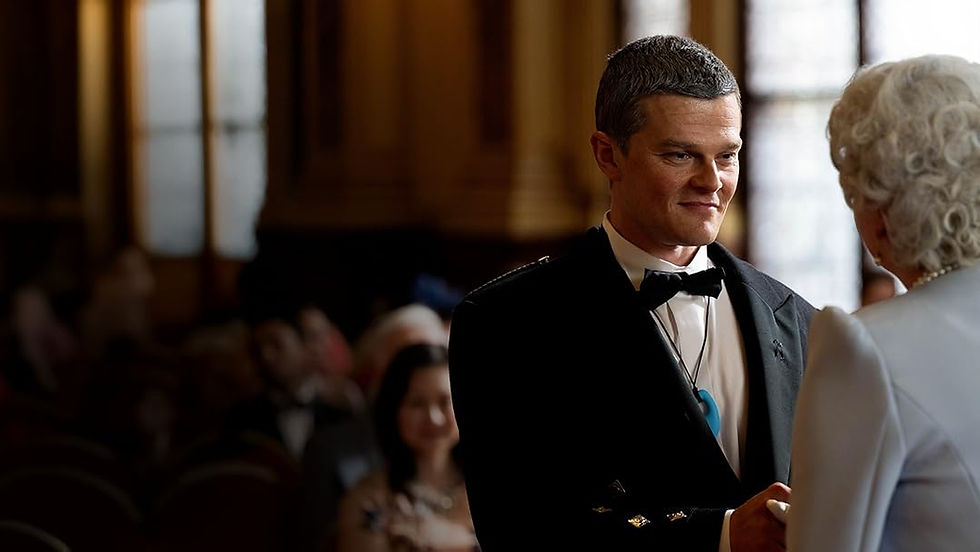
"I'll embarrass myself, Dottie. I'll say something I regret."
Most biopics flatten people. They take a life that was messy, contradictory, occasionally ugly, and sand it down until it fits neatly into a two-hour arc you can applaud on the way out. "I Swear" doesn't quite escape that gravitational pull, but it pushes against it in ways that matter, not by reinventing the form, but by paying closer attention to the person at the center of it.
That person is John Davidson (Robert Aramayo), who develops Tourette's syndrome as a teenager. It's a condition that, at least in the public imagination, tends to get reduced to the most sensational symptom: the involuntary blurting of expletive language. The film doesn't ignore that aspect; it actually leans into how disruptive and socially awkward it can be. Not just the obvious stuff like school or work, but the quieter, more corrosive things like family dynamics (John's parents' divorce as a result, and his mother harbors resentment towards her now adult son), as well as John's self-worth, and the exhausting code-switching John must perform behind every social interaction.
What follows throughout John's suburban British life isn't melodrama so much as expansion. Teachers punish what they don't understand, while classmates turn cruelty into sport. At home, John's parents aren't villains, but they're people with a limited framework trying to force an unfamiliar problem into something recognizable.
Discipline replaces curiosity. Embarrassment overrides empathy. There's a particularly painful throughline in how quickly John goes from being a promising kid to being treated like a disruption that needs to be managed.

Thirteen years later, the risks are settling into something more conventional. Adult John is still living with his mother (Shirley Henderson), heavily medicated, and largely stuck. Enter Dottie (Maxine Peake), a nurse with terminal cancer who, similar to Sandra Bullock in "The Blind Side," feels like a walking life lesson as a mentor in waiting. She understands what he can't control, and more importantly, she treats him like a person regardless of his condition.
That shift is what starts to change John's trajectory. Dottie brings him into her home, helps him ease off the medication that's been dulling more than just his tics, and nudges him toward some version of independence. A job at a community center introduces him to Tommy (Peter Mullan), who fills the familiar role of gruff ally but with just enough texture to avoid feeling like a stock character. These relationships are the film's strongest argument that Tourette's doesn't become easier, but that the environment around it can become a wee bit more humane.
Aramayo's performance is doing a lot of heavy lifting in "I Swear," and for the most part, he earns it. The physicality is precise without turning into a showcase, which is always the risk with roles like this. More importantly, he lets the tics become part of a larger behavioral language rather than the whole thing.
The film also allows John to be frustrating, which is crucial. I grew up with someone with Tourette's, and from personal experience, the tics that John exhibits feel real and pretty self-explanatory. To the point that he is often getting into trouble with the police as social interactions bring confusion into his environment, where he accidentally hits a stranger in a bar, makes a crude remark towards a pretty woman walking by, and so on.

These are unintentional "mistakes" that have real consequences for his physical, emotional, and social well-being... so much so that they still haven't gone away. Just this year, the real John blurted out an offensive term directed towards Michael B. Jordan and Delroy Lindo at the BAFTA Awards, and the constant apologizing is something the real John and Aramayo's version know all too well.
If there's a place where "I Swear" stumbles, it's in the back half, when it starts to feel the need to cover too much ground. Legal troubles, advocacy work, public speaking, experimental treatment...it's all compelling material, but it's packed in so tightly that some moments don't land with the weight they should. The film is at its best when it lingers, when it trusts a scene or a relationship to carry meaning without rushing to the next milestone.
But, there's humor, too, and it's sharper than you might expect. Some of John's verbal tics land like punchlines, rapid and absurd, and the film lets you laugh without immediately scolding you for it. Then it turns and shows you the cost of those same outbursts in a different context.
It's a tricky balance, but it works more often than not.
"I Swear" may not completely break free from the biographical film genre's structure, but it does something more valuable: it resists the temptation to simplify the life it depicts. It doesn't ask for sympathy so much as attention. By the end, that feels like the more honest ask.



The review highlighted how the film treats Tourette's with humanity and respect instead of turning it into a simple story. I remember watching a movie in class about living with challenges, and it changed the way I understood other people's experiences. During that busy semester, I searched for pay someone to do fashion assignment because I was overwhelmed with deadlines and coursework. The post reminded me that good storytelling can help us become more understanding and compassionate toward others.