


'The Odyssey' Review: Matt Damon Anchors Christopher Nolan's Giant, Thunderous Adventure
- Matthew Creith

- Jul 15
- 4 min read
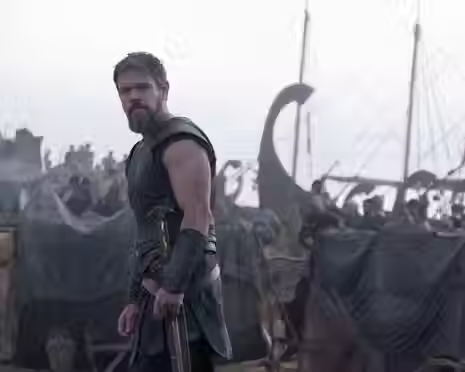
Director Christopher Nolan has spent much of his career crafting movies that demand the biggest screen possible, but "The Odyssey" may be the clearest realization yet of that ambition. Shot entirely with IMAX film cameras, the filmmaker's adaptation of Homer's legendary epic isn't simply a movie you watch...it's an experience. Nearly every frame is built for towering screens, every action sequence rattles the theater, and Ludwig Goransson's thunderous score ensures the experience is felt as much as it is heard.
This is blockbuster filmmaking operating at maximum volume.
The film follows the legendary Greek king Odysseus (Matt Damon) as he struggles to return home to Ithaca after spending 10 years fighting in the Trojan War. What should be a straightforward voyage stretches into another decade as he encounters mythical creatures, treacherous seas, vengeful gods, and impossible moral choices that test both his leadership and his humanity. While Odysseus battles his way across the Mediterranean, his wife, Penelope (Anne Hathaway), fights to preserve their kingdom from a growing number of ruthless suitors eager to claim her throne. At the same time, their son Telemachus (Tom Holland) embarks on his own journey to discover whether his father is still alive and worthy of the legendary reputation that has defined his family for two decades.
As father and son pursue parallel paths toward home, Nolan weaves together an epic tale of war, sacrifice, redemption and the enduring hope of returning to the people who matter most. Battles, monsters, storms, betrayals and escapes arrive in rapid succession, giving audiences remarkably little time to catch their breath before the next spectacle crashes onto the screen. For some viewers, that constant intensity may become exhausting, as there are moments when the film could benefit from pausing long enough for its emotional beats to resonate more deeply.

Instead, Nolan seems determined to keep the audience moving forward, sacrificing some intimacy in favor of scale.
Matt Damon anchors the chaos with one of the strongest performances of his career as his version of Odysseus isn't just chiseled and hot...he is portrayed as a battle-scarred man weighed down by the consequences of war and the burden of trying to find his way home. Damon carries the film's emotional core without ever asking the audience to forget the character's flaws. His intelligence, arrogance, determination, and guilt coexist throughout the journey, making Odysseus feel surprisingly human despite the larger-than-life circumstances surrounding him.
Nolan has also assembled one of the decade's most impressive ensembles, although not everyone receives equal screen time. In many ways, the cast resembles a cinematic relay race, with major stars appearing just long enough to leave an impression before passing the baton of a story to the next character. It's a testament to the strength of the performances that even actors who only appear for mere minutes manage to stand out.
Anne Hathaway brings quiet resilience to Penelope, portraying a queen, mother, and depressed wife who has spent decades refusing to surrender hope. Robert Pattinson embraces his villainous role as a main suitor with obvious enthusiasm, delivering one of the film's most entertaining performances whenever he appears. Samantha Morton nearly steals the movie entirely during her unforgettable sequence as the wicked Circe, while John Leguizamo provides some of the film's most heartfelt moments as the blind servant loyal to his master.

Other A-list names, including Zendaya, Lupita Nyong'o, Charlize Theron and Jon Bernthal, have far less screen time than audiences might expect. Yet rather than feeling wasted, many of these performances function as memorable chapters in Odysseus' sprawling journey. Nolan clearly prioritized assembling the right performers for each encounter rather than ensuring every star received equal prominence.
Visually, "The Odyssey" is breathtaking. Cinematographer Hoyte van Hoytema once again proves why he has become one of Nolan's most valuable collaborators, capturing vast coastlines, towering cities, and violent seas with extraordinary clarity. Whether depicting massive battles or intimate confrontations, the imagery consistently reinforces the sheer scale of the story.
Not every creative decision lands perfectly, though. Nolan's fractured storytelling occasionally makes an already sprawling narrative feel more complicated than necessary, and some emotional relationships receive less attention than they deserve amid the constant forward momentum. The script calls for characters to say "fuck" and "mom" or "dad" rather than the language of the Greeks, though the Americanization of an epic poem at least lends the story a more modern touch.

Even when individual scenes don't fully connect, the craftsmanship behind them remains undeniable.
Ultimately, "The Odyssey" succeeds because it embraces spectacle without apology. Nolan doesn't attempt to shrink Homer's epic into a conventional historical drama or modern prestige picture. Instead, he leans fully into its mythic scale, delivering an adventure that feels enormous from beginning to end.
It's big, LOUD, and almost relentlessly action-driven for the better part of its three-hour runtime.

Whether or not it ultimately ranks among Nolan's very best films will undoubtedly be debated, but one thing feels certain: this is exactly the kind of movie that movie theaters were built to showcase. In an era when so many blockbusters feel interchangeable, "The Odyssey" delivers something increasingly rare.
A genuine cinematic event that demands to be experienced on the largest IMAX screen available.


Comments